
This website uses only technically necessary cookies. We do not use analytics, marketing or personalisation services. More in our privacy policy.
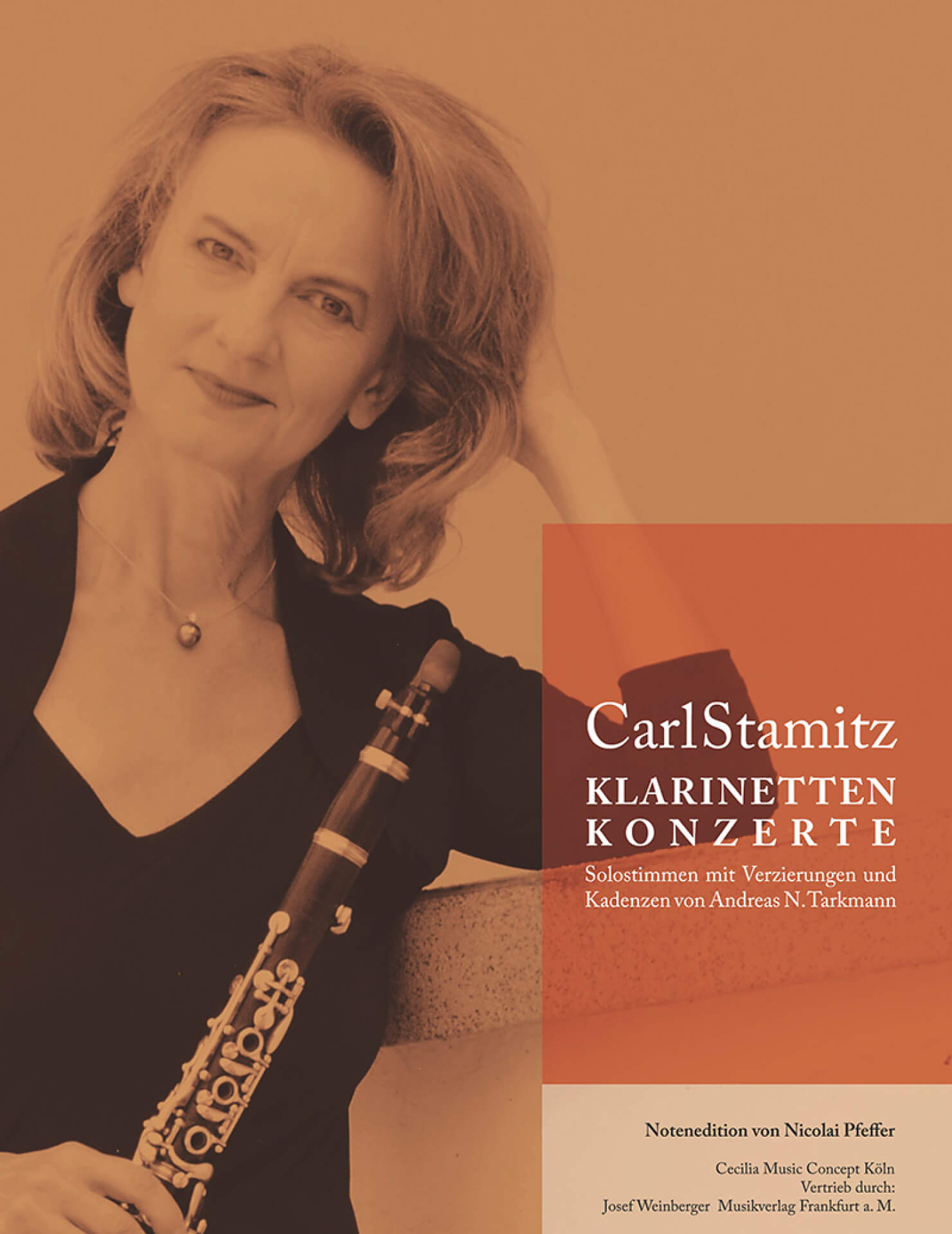

Andreas N. Tarkmann on his edition: musicological research suggests that soloists still enjoyed considerable freedom of ornamentation and improvisation after the Baroque era. On this basis I revised the solo parts of Stamitz’s clarinet concertos, taking Mozart’s instrumental concertos, with their cadenzas and melodic embellishment, as my stylistic model. Every addition aims to preserve the musical flow, or to create it where overly schematic, block-like writing breaks it up.
Since the modern clarinet surpasses the instrument of Stamitz’s day in the intonation of its different registers, I thinned out passages that sometimes cluster in the high register and moved them into lower registers for variety. This allowed me to fulfil Sabine Meyer’s wish to turn Stamitz’s somewhat academic concertos into effective, fully fledged solo works. Thanks to her recordings (Vol. 1 and 2), the concertos in my version have reached a much wider audience. Frequent requests for my cadenzas and ornaments led me to bring all my work on these concertos together in a single volume. My sketches, drafts, ornaments and cadenzas date back more than thirty years and existed only as a mixture of handwritten notes and printouts from early notation software. The clarinettist Nicolai Pfeffer, who has since also become known as an editor of clarinet music, has reviewed all these scores and carefully prepared them for practical use.
To keep the size and price of the collection reasonable, we have limited it to the clarinet parts with my ornaments, including all cadenzas. They are fully compatible with all current piano reductions and other printed editions and can easily be compared with them by bar numbers, so that every performer can try out their own version.
The additional markings for articulation, phrasing and dynamics are intended as suggestions. The appendix contains the cadenza I wrote for Sabine Meyer for the first movement of Johann Stamitz’s concerto; it dates from a few years earlier, when we were students together in Hanover.


