
This website uses only technically necessary cookies. We do not use analytics, marketing or personalisation services. More in our privacy policy.
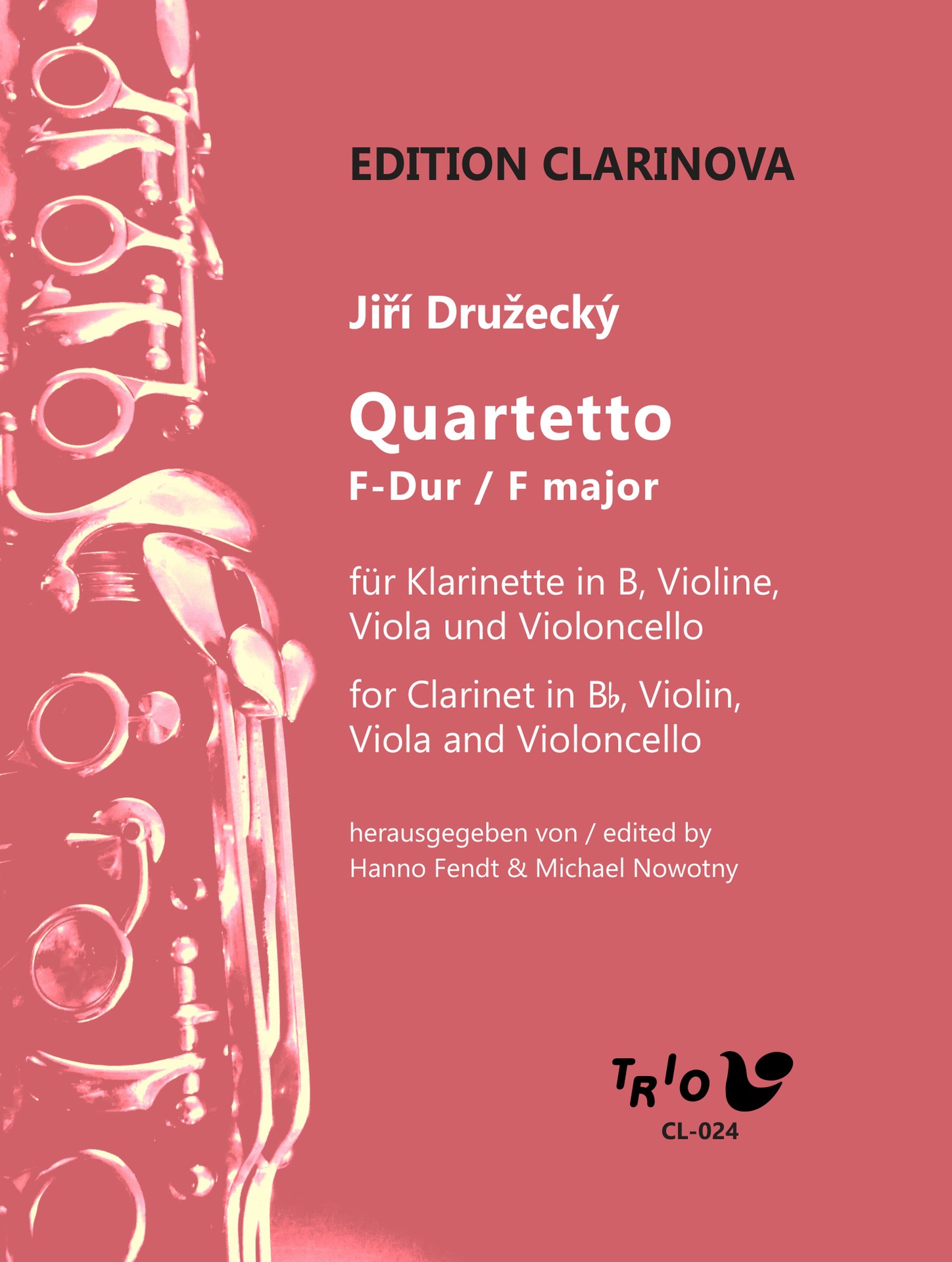

Jiří Družecký (1745–1819), known in German as Georg Druschetzky, began as a military musician and oboist and studied with the Dresden court oboist Carlo Besozzi. After years as a regional timpanist in Upper Austria and in Vienna, he served Duke Grassalkovich in Pressburg, Prince Primate Batthyány in Hungary and, from 1807, Archduke Joseph, whose eight-part wind band he directed. His large output includes 28 symphonies, some 150 wind partitas, string quartets, masses and operas; today he is known mainly among wind players.
The Quartetto for B flat clarinet, violin, viola and cello, in a key rarely found for this scoring, appears here for the first time in a modern edition with full score. The source is a manuscript set of parts (dated by RISM between 1800 and 1824) in the library of the Franz Liszt Academy of Music, Budapest.
Editorial additions are given in brackets; significant departures from the source are explained in footnotes. Score and parts; preface (German/English) by Hanno Fendt.


